


Business Community Recognises: “Cooperation Between Suriname and Guyana Is a Necessity”
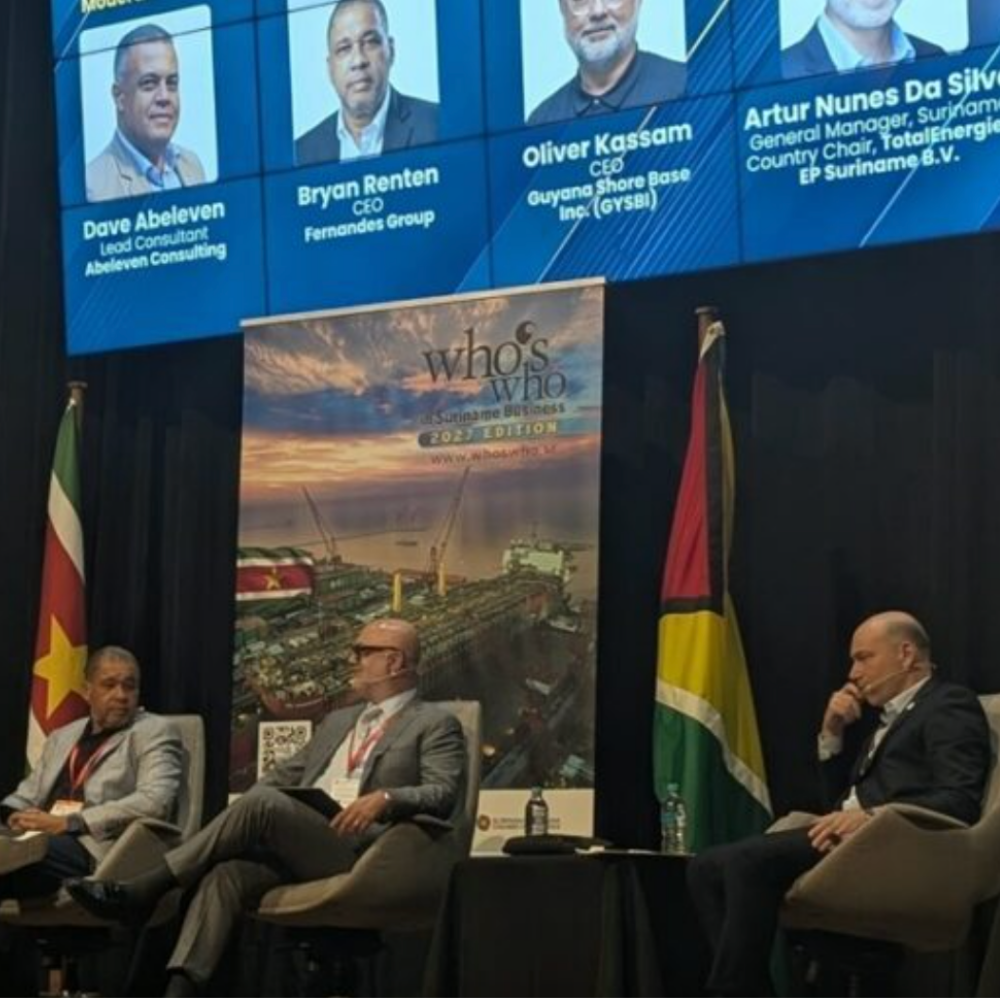
Business leaders highlight opportunities and challenges in regional cooperation
By Euritha Tjan A Way | de Ware Tijd | 16 October 2026
During the CEO panel, featuring Dave Abeleven, Bryan Renten, Oliver Kassam and Artur Nunes Da Silva, business leaders shared their perspectives on the theme “From Energy to Industry.”
PARAMARIBO — “Did you ever think this would be possible? Could you have imagined ten years ago that Guyana and Suriname would undergo this kind of development? I certainly could not,” said Virjanand Depoo, Guyana’s ambassador to Suriname, enthusiastically. His optimism was evident in his expressions and gestures. “There are so many opportunities. We need to move from potential to realisation. That is the challenge.”
Depoo participated in the so-called Ambassadors’ Panel, entitled “Building a Regional Platform: Cooperation as the Foundation for Industrial Growth.” The panel was one of three sessions held on the first day of the International Business Conference at the Assuria High-Rise Event Centre. Depoo indicated that political differences between Suriname and Guyana would eventually be resolved.
“In Suriname, we talk a lot but do very little. That really needs to change now.”
— Bryan Renten, CEO of Fernandes Group
Lessons LearnedSuriname’s ambassador to Guyana, Ivan Fernald, also participated in the panel. He said Suriname could learn from Guyana’s experience and understand the lessons it had learned along the way.
“We do not have to make the same mistakes. That puts us in a privileged position,” he said.
Fernald, who presented his credentials to Guyana’s president on 16 September, suggested that the private sector should have a greater influence on the development ambitions of both countries.
“Although I see opportunities for partnerships, there are also enormous challenges. Surinamese entrepreneurs must be able to meet very high international standards. Can we do that on our own, or should we work with Guyana so that we can become a force to be reckoned with?”
According to Fernald, the organising body, the Suriname-Guyana Chamber of Commerce, has demonstrated that it can fulfil its role as a matchmaker between businesses and potential partners.
ChallengesDespite the opportunities, significant challenges remain for Suriname and Guyana to work together. This was highlighted by Bryan Renten, CEO of Fernandes Group, during the CEO panel discussion entitled “From Energy to Industry.”
Addressing the Minister of Transport, Communication and Tourism, Renten spoke candidly:
“I am going to say it as it is: how difficult can it be to operate a ferry or a boat service at the border between Guyana and Suriname? We cannot even manage that!”
Fernandes, which expanded its operations into Guyana even before the oil and gas developments began, has experienced these difficulties firsthand.
“We were looking for an opportunity to expand our market because we are the market leader in Suriname for beverages and bread. Guyana, and to a lesser extent Barbados, seemed like potential markets for us in the region,” Renten explained.
However, after several years, basic infrastructure and connectivity remain significant obstacles.
Renten described cooperation between Guyana and Suriname as essential.
“It would be absurd for Guyana to have a gas-to-shore facility while Suriname builds one of its own. That makes no sense. Both countries have relatively small populations,” he said.
Artur Nunes Da Silva, General Manager of TotalEnergies EP Suriname, highlighted another major issue: obtaining work permits.
“Given the number of people we need, we require thousands of work permits. I know there is a gap between what the government was previously able to handle and what it needs to manage today, but we genuinely need a better process.”
Local ContentLocal content remains a key topic of discussion when it comes to offshore investment. Renten said he struggled to understand why the subject continued to be discussed without meaningful action being taken.
“I recommend that the government approach local content as a process. We will not have maximised local content within two years, but let us start with a vision. What do we want, and where does Suriname want to be in two years and in four years? Let us at least do something.
“In Suriname, we talk a lot but do very little. That really needs to change now,” Renten stressed.
For companies that are already investing, it is also important that the government makes decisions that support local content development.
“Fernandes, for example, is already investing, but does not receive tax incentives from the government. We need to bring in people from abroad because we lack the necessary expertise in certain areas. To do that, we need work permits, and that is a real problem as well.”
Stakeholders see opportunities for Suriname and Guyana to cooperate across a range of sectors, not just oil and gas.
“We need to look beyond oil and gas and encourage sustainable initiatives,” Renten concluded.
Thursday marked the final day of the International Business Conference 2026.
Original Source: https://dwtonline.com/business-community-erkent-samenwerking-tussen-suriname-en-guyana-is-noodzaak/